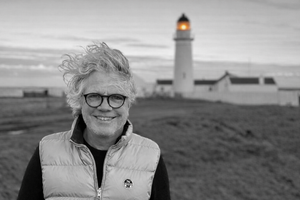
A boy's answer to a teacher's question
When I was fifteen, our teacher asked the class what we wanted to become. I answered without hesitation. I wanted to build and develop sailing yachts. At the time, I was completely mesmerised by a television series called Howard’s Way. Once a week you could not drag me away from it, and although I obviously did not realise it then, I think the seed was planted somewhere around that time, young enough that I did not even know it had been planted.
Years later, after winning my first transatlantic yacht race, I left my job at a large corporate organisation, traded the suit, tie and polished shoes for Converse All Stars and jeans again, and turned that boy’s answer to a teacher’s question into an actual life. I started building and developing racing yachts, award winning ones that went on to collect plenty of trophies in regattas around the world, and for a long time I could not have imagined wanting to do anything else.
But somewhere along that journey, I began to understand more about what building yachts actually costs the environment. That was not an easy thing to discover about something I loved and was genuinely proud of, because suddenly two things that seemed impossible to reconcile were true at the same time. I had built a life around an industry that fascinated me, while that same industry had an environmental impact I could no longer ignore. The more I read, and the more I checked the facts myself rather than simply accepting what I was told, the harder it became to look away. I did not stop loving yachts or wanting to build them. I simply stopped accepting that the way we had always built them was the way we had to keep building them.
So for two years I broke my head, and a fair amount of material, trying to bend a linear industry into a circular one. There were plenty of ideas that seemed brilliant until we tried them, plenty of things that broke when they were not supposed to, and plenty of moments when the easiest conclusion would have been that something simply could not be done. What those years taught me was that what we call impossible is often just a problem nobody has stayed with long enough yet.
Working in that startup has become one of the most inspiring stretches of my entire career. Most mornings begin in much the same way, up early, coffee and breakfast, walking the dogs along the Irish Sea and arriving at my desk with my head already somewhere in the problem we were working on the day before. Then I spend the day alongside one of the smartest people I have ever worked with, in a place where a genuinely great idea can be applauded on Monday and end up in the recycling bin, sometimes quite literally, by Friday because something better appeared in between.
There is something about that process that reminds me of sailing towards a start line, where everything is moving at once and you are constantly adjusting, slowing down hard one moment and accelerating again the next, reading what is happening around you and knowing that whatever plan you had five minutes ago may already have become irrelevant. The difference is that here there is no finish line everyone has agreed on. Every time we reach something that works, someone asks whether it could work better, and somehow that question has become one of the things I enjoy most about being there.
Sometimes I think back to that classroom and the fifteen year old boy who knew exactly what he wanted to become, and what strikes me now is that his answer was never wrong. Building and developing yachts gave me an extraordinary life. It took me across oceans, into workshops and boatyards, through races, successes and failures, and introduced me to people and places that boy could never have imagined. I would not undo any of it.
I simply know things now that he could not possibly have known then.
Perhaps that is one of the more beautiful things about getting older. A dream does not necessarily have to disappear when you begin to see its imperfections. Sometimes it survives precisely because you allow everything you learn along the way to become part of it. The dream stays, but the responsibility that comes with it changes, and somewhere along the way the question of what you want to become quietly turns into another one: what do you want to do with everything you know now?
Thirty years later, if that teacher walked into the room again and asked me the same question, I think my answer would come just as quickly as it did the first time. I would still tell her that I want to build and develop sailing yachts, only now I know what kind of yachts I want them to be.