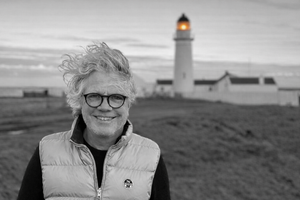
Some mornings on the Isle of Man the wind comes straight off the sea, and I walk right into it with my dogs. Horizontal rain, as we call it here, and that is not a figure of speech: it comes at you sideways and straight into your mouth. The storm is so rough that it's a wonder I still have any hair left on my head. And I laugh. Sometimes I say it out loud: come on then, is that all you've got?!
Other mornings I walk out under the stars and watch the sky turn from black to deep blue, then orange, yellow, light blue, every colour you can name, all before the sun is even up. I stop, take it in like a sponge, and catch myself saying thank you out loud to nobody in particular.
And on the days the sky does not do it, a song in the car will. In My Arms Again by The Prayer Boat gets me every time. Emmett Tinley's voice, and before I know it, I am moved.
And then there are my dogs. Not long ago my young dog Finn nearly choked on a piece of wood. I held him upside down until it came out, raced him to the vet, and had to leave him there, alone for the first time in his life. His mother Quattro went home with me, looking back for him the whole way. It was close, much closer than I like to think about. When I picked him up, he did not leave my side for three days, curled up against me wherever I sat, and I would not have had it any other way. Somewhere in those three days I understood how little had stood between me and losing him, and whatever I had been holding up just came down.
What those moments have in common is that I do not have to be anything for them. A storm does not judge you. A sky does not decide you are not good enough. A song does not change its mind about you, and a dog asks for nothing but you. So that is where my shield comes down, easily, because it is safe.
Most of us carry that shield through the day, often without noticing. At work you keep a certain distance. When I was building yachts, we had a fairly small team, and I was always there for them, but I was careful not to become one of the guys. Someone has to make the decisions, and that is easier from a little further away. Many of us, men especially, learned early on to keep a straight face. People can hurt you, by what they say, by what they choose, by leaving. The shield is there for that. Sometimes you need it.
I remember the day the first yacht of a new design stood finished on her cradle in the yard. A first of a kind means reinventing everything, every step learned again from scratch, and we had been through all of it together. So we threw a party and invited everyone who had been part of it: the whole team, their partners and their children. It was also a thank you to the partners, because to get her finished we had sometimes taken people away from them with overtime and long days. When she left the yard for the first time, men with arms thicker than my legs stood there with tears in their eyes. For once nobody was the boss and nobody was keeping a straight face. Every shield in that yard came down at the same time, mine included.
And yet, when I think of the people who have mattered most in my life, the friends I would drop everything for, the people I love and have loved, none of them are there because they were impressive or useful. They are there because, at some point, they disarmed me.
I know what it costs to lower it in front of people. When I wrote Grief and gratitude, I shared something I had never written about publicly before: losing someone I loved, far too soon. I hesitated for a long time. I had not been hiding it from myself, I had simply kept it close, and letting other people see it felt different. But it moved people, and many of them shared it. More than a few, I suspect, recognised something of their own loss in it. None of that would have happened with the shield up.
It turns out there is research on this. In 2018, three psychologists at the University of Mannheim, Anna Bruk, Sabine Scholl and Herbert Bless, asked people how they judged moments of openness, like admitting a mistake or confessing feelings. When people imagined doing it themselves, they saw a mess. When they watched someone else do exactly the same, they saw something beautiful. The researchers called it the beautiful mess effect. From the inside, it feels like a mess. From the outside, it looks beautiful.
It is a strange thing. We protect ourselves most carefully in exactly the place where life has the most to give. Maybe the shield is not there to keep everyone out. Maybe it is there so we can choose who gets close.
Lowering it in front of other people can be frightening. It is also the only way in.