The country I left but never left behind
I was born in the Netherlands. More specifically, I was born in Holland, which still makes me smile when people outside the country use Holland and the Netherlands as if they are exactly the same thing. Holland is only two provinces; the Netherlands is the whole country. We Dutch are very precise about these things, until we start talking about bicycles, measurements or how much cheese we have eaten.
There is another detail that only really makes sense to me in hindsight. I was born in Dordrecht, the oldest city in Holland, and, as a matter of fact, an island itself, surrounded on all sides by rivers. You barely notice it growing up. You simply cross a bridge and you are on the other side, so there is nothing particularly dramatic about it. But perhaps that is where it started. I eventually ended up on another island, the Isle of Man, where getting to the other side means a ferry or a plane rather than a bridge, and somehow the feeling is still familiar. There is a particular mentality that comes with living somewhere the water decides where you end and the rest of the world begins.
I have lived in six countries in total, and for most of my adult life I have actually lived somewhere other than the Netherlands. People sometimes ask me why I left, and the answer is simple: it was too busy for me. The Netherlands has more than 18 million people living on roughly 42,000 square kilometres, which makes it the fourth most densely populated country in the world among those with more than 7.5 million people. There are roads everywhere, houses everywhere, towns growing into other towns. There are calmer corners and beautiful places too, but it is surprisingly hard to find somewhere you cannot see, hear or notice somebody else. What suits me is the sea, open space, and a walk of an hour that actually takes me somewhere. I left because I knew what I needed, not because I disliked the Netherlands.
The strange thing is how much of it I still carry with me, and above all the directness. In France, in the United Kingdom and here on the Isle of Man, saying exactly what you think can come across as rude, or even as an insult. For a Dutchman it is the opposite. Being direct is how we show respect, because it means we do not waste each other's time. No circling around the point, no ceremony first. You say what you think, the other person knows where they stand, and you both get on with your day.
And then there is time. I would rather be an hour early than one minute late. In fact, I am never late. Not once, not ever. Dutch humour is much the same: plenty of people do not find it funny at all, but few nations take the piss out of themselves quite as easily. And if something needs doing, someone will usually work out how to do it rather than spend three weeks discussing whether it might be worth considering doing it.
Some of that probably comes from centuries as a trading nation, and some from simply being such a small country. Whatever the reason, I noticed it very early in business. When I was building yachts, I knew from day one that I could never build a company on the Dutch market alone. It was simply too small to make sense. My first thought was never where I could sell something at home; it was always where in the world I could sell it. Talk to people from bigger countries and you notice the difference. Their own country is often big enough for them. For us, it never is. That is one of the reasons the Dutch tend to look outward.
This is what happens when you spend most of your life abroad. You carry little pieces of the country you left behind with you. My logo is orange, and so, somehow, is my watch strap. Every time I go back, there is something wonderfully familiar about being able to speak my own language everywhere. You do not have to explain the joke, you do not have to explain why you are being direct, and you can just get on with it. I am very proud to be Dutch. I just do not want to live there, and that used to seem like a contradiction to me. It does not anymore.
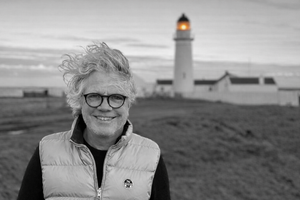
The Isle of Man has become home in a very different way. The wildlife, the landscape, the sea and the space are all part of it, but it is the people who make the difference. They still say good morning, good afternoon and good evening to strangers here, and they mean it, and that small, old-fashioned politeness carries a real warmth with it. I can go away for two weeks and leave my front door unlocked, and when I get home, the postman has simply let himself in and left my parcels on the kitchen table, waiting for me. That kind of safety, and the kindness behind it, is something I did not expect to find anymore, anywhere. Sometimes it feels as if life here simply forgot to hurry.
The Isle of Man is a little like a cruise ship. Everything you need is there: beautiful scenery, good food, friendly people, nature and the sea. You can settle in and be perfectly happy, but every now and then you really want to get off. That is one of the things I find most amusing about living here. It is one of the few places I know where, when I am on the boat leaving the island, I think, "Lovely. I'm getting off." And then, when I am on the boat coming back, I think, "Lovely. I'm going home." There is something rather special about that.
Home does not have to be the place where you were born, and it does not have to be the place you stay forever. You can leave somewhere without leaving it behind. The Netherlands gave me my language, my way of looking at things and probably quite a few habits that people in other countries find slightly odd. I simply found somewhere else that suits me better.
That is the difference between the two islands I have lived on. One I left because I needed space. The other I stayed in because I never had to lock the door.
So here is a question worth asking yourself. Where do you still feel that you do not have to explain yourself? Where would someone let themselves in and leave your parcels waiting on the kitchen table? For some people that is the place they grew up, for others it is somewhere they chose, and for me it sits on two different islands, one that gave me my language and one where I never have to lock the door. It is easy to describe where you live by the size of the house, the town or the postcode. It is harder to ask where you can be yourself.
Home, I think, is the place that still leaves its door unlocked for you.