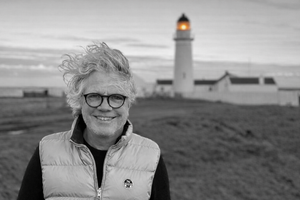
What I got wrong about small communities
For most of my life I lived in big cities, Marseille, Brussels, Cape Town, always moving between my own things, my own friends, my own pace. I never looked down on anyone, and I never looked up to anyone either, that is a separate conversation, but I did carry one assumption for years without ever really examining it. I thought small communities would not fit me. I pictured exactly what people warn you about, everyone watching everyone, everyone knowing everyone's business, what we call in Dutch “betuttelend”, a kind of tight, gossipy closeness I wanted no part of.
Now I live on the Isle of Man, roughly 85,000 people on the whole island, and I live in the fourth largest town, which holds maybe 3,000 of them. I was wrong about almost all of it.
What I actually found here is not surveillance dressed up as community. It is people looking out for each other. You see the same faces every day, at the shop, on the road, at the coastline walking their dogs, and instead of that becoming claustrophobic, it becomes something closer to accountability. People look out for each other because they will see you again tomorrow, and the day after that.
The proof is in the small, unremarkable moments. A car breaks down on the side of the road, and someone stops, not because they know the driver, simply because that is what happens here. An elderly neighbour struggles with heavy shopping bags on the walk home, and you carry them the rest of the way without either of you making it into a whole conversation. People say good morning, good afternoon, good evening to almost everyone they pass on the street, simply because that is how people greet each other here, and after a while you stop noticing you are doing it at all.
It is easy to underestimate those things because none of them are especially important on their own. No single person stopping for a broken down car changes the world. Carrying someone's shopping home is hardly an event worth remembering. Saying hello to someone you do not know is barely an action at all. But put enough of those moments together and you start to notice that something has changed around you. There is a sense that you are part of a place rather than simply living in it.
In winter, when things genuinely get rough, that dependence on each other stops being a nice idea and becomes the thing that actually gets people through it. Roads close, services slow down, the weather takes over and suddenly the people who live around you matter in a very practical way. You may not know their names, but you know someone will probably stop if something goes wrong.
I think that is what I misunderstood about small communities. I had confused being known with being watched.
Living in cities, anonymity had always felt like freedom to me. You could come and go without anyone noticing, build your own life without much interference, and that independence was something I valued. I still do. But I did not really appreciate the other side of it. Anonymity can also mean that nobody notices when you need a hand.
You can be surrounded by millions of people and still be entirely on your own if your car breaks down at the wrong moment.
I am not saying everyone should move to a small island. Cities give you things a place like this never will, and I do not regret a single year I spent in any of them. I still enjoy the energy of cities, the variety, the anonymity, and the freedom to disappear into a crowd when you feel like it.
But I wish someone had told me earlier that the closeness I was avoiding and the surveillance I feared were not actually the same thing.
One is people knowing your business. The other is people simply being there when it matters, without needing to be asked.
And after living here for a while, I have started to think that perhaps the second one is worth a little more than I used to give it credit for.